
By Nico Rosenberg
From Argentine Rock to the World: A Conversation with Engineer Guido Nisenson
From tape machines to chaotic Charly García sessions, a fifty year friendship with Andrés Calamaro and decades of work with Luis Alberto Spinetta, the engineer looks back on a career built across different continents.
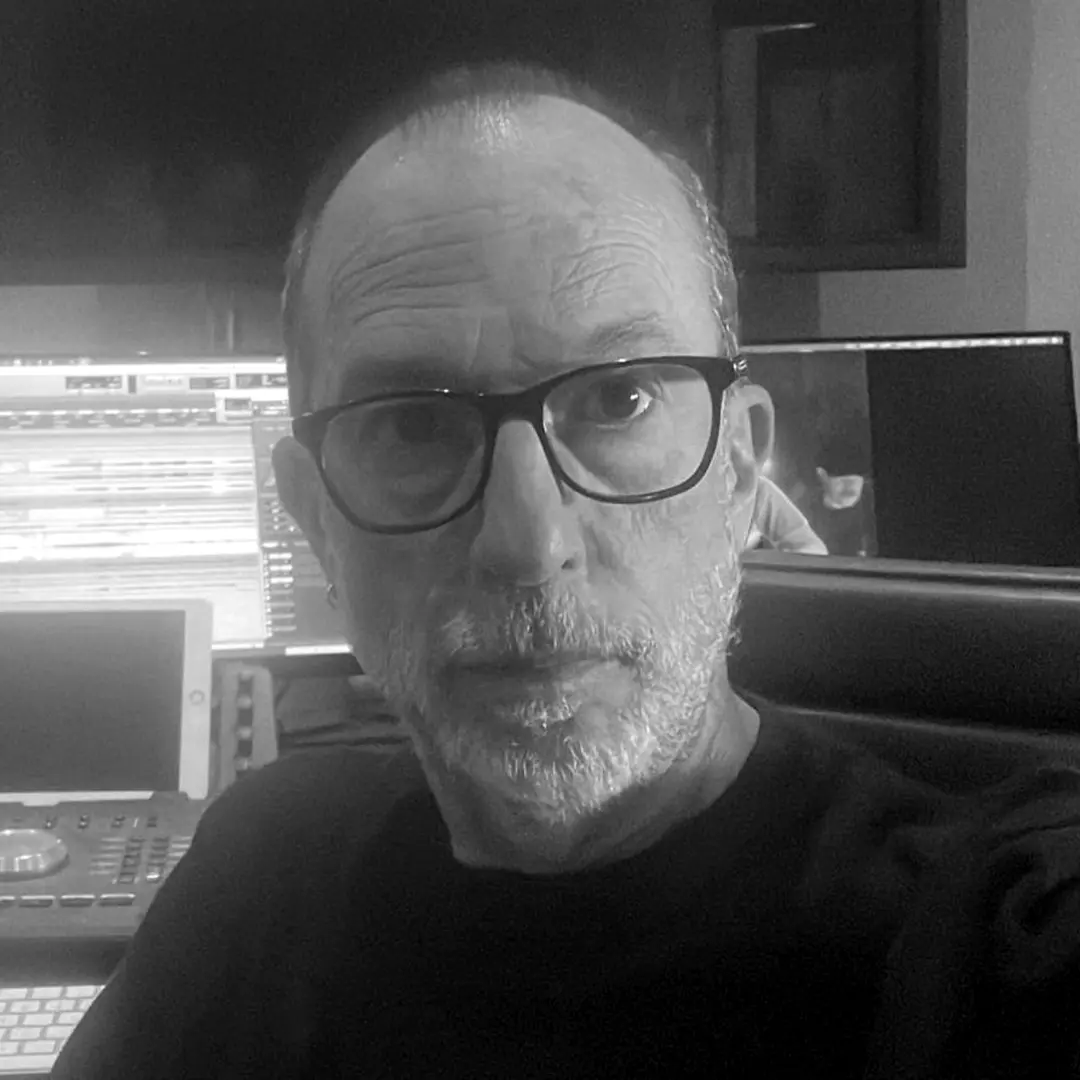
Guido Nisenson is, arguably, the most emblematic sound engineer to come out of South America since the 1990s. Born in Buenos Aires, Argentina, he has worked with some of the biggest names in modern Argentine music: Charly García, Luis Alberto Spinetta, Andrés Calamaro and Mercedes Sosa. He also spent years living in Santiago, Chile, where he recorded major names from the Chilean scene. He has also recorded in China, India, the United States and Mexico among other places. Now lives in Madrid, Spain, where he keeps recording artists and runs sound for the well known Café Berlín. We sat down with Guido to talk about his career and what he would bring to a desert island if he had to mix a record without a computer.
A T-shirt with history
Before we get into it, something catches the eye: Guido is wearing a T-shirt printed with two older men, dressed formally, one kissing the other on the cheek. They are two heroes of Argentina. Roberto Goyeneche, nicknamed “El Polaco,” one of the greatest voices in Argentine tango, and Osvaldo Pugliese, a tango orchestra conductor whom Guido describes as a kind of good luck charm: on tours by Argentine music groups, he says, someone always brings along his image. Pugliese was also a singular figure off stage: an idealistic communist of the 1930s, from the strand that dreamed of a better world for everyone, and who, when people called him “maestro,” would answer that he was simply “a worker of music.” For Guido, the image of these two old friends sharing a kiss is a fitting representation of the value of friendship. Perhaps, without saying it, they are his real reference points, both as artists and as human beings.
Los Tres, Calamaro and a career without borders
Ask Guido about the most important records of his career and he doesn’t hesitate to bring up La espada y la pared, by Los Tres, recorded to tape with producer Mario Breuer. He says the band ended up at odds with that production: Breuer wanted a more pop record, while Los Tres were already chasing something else, something rawer. The result is a record Guido still listens to today, and one that carries enormous weight in Chilean rock: it arrived right at the start of the country’s return to democracy, at a moment when Chile needed new sounds and new artists. That same decade, he also recorded Fiskales Ad-Hok, Joe Vasconcellos and Los Ex, to name a few Chilean acts.
His career moves across genres and countries with the same ease. On the Argentine side, he recorded Honestidad Brutal with Andrés Calamaro, an album made across Buenos Aires, Madrid, Miami and New York during the tour for Calamaro’s previous record. The mixing sessions were done by Guido at Crescent Moon Studios, the studio built by Gloria and Emilio Estefan and home base for the Miami Sound Machine, a legendary room for Latin music where the owners themselves recorded and where, through the 90s, icons like Celia Cruz, Ricky Martin and Marc Anthony also came through to record among others.
Unlike other projects, Guido never needed to “study” Calamaro’s style before getting to work: the two have known each other since they were fifteen, they’re contemporaries, and behind that there are fifty years of friendship, touring and recording together.
With Charly García, another towering figure of Argentine rock, he worked on Say No More. Around that same period, he also engineered Alta Fidelidad (1997), Mercedes Sosa’s album of Charly García songs. Sosa is the greatest voice of Argentine folk music, known across the region as “the voice of Latin America” and the idea for the record came from García himself: an album built entirely out of his own songs, sung by her. They tracked it at Luis Alberto Spinetta’s own studio, Diosa Salvaje, with Guido engineering and Joe Blaney producing alongside him.
Guido remembers the sessions as pure chaos. Recording the vocal for the opening track, “Cuchillos,” ran late into the night, and García wanted to sing from the bathroom. Guido said fine, he’d run the cables in there, no problem. Then García asked to sing sitting in the bathtub. Still fine, Guido said. Then García wanted the tub filled with water. That’s where Guido drew the line: cables, electricity and water don’t mix, and he didn’t want to end up in the papers as the engineer who electrocuted Charly García. Another night, while Sosa sang live to tape, García sat off to the side running her vocal through a chain of his own guitar pedals in real time, stomping on them like a man possessed and printing everything that came out onto a separate track. “Pure madness, none of it usable,” Guido says. “We tracked take after take of garbage.” Finishing the record was chaotic and genuinely difficult, he says. García was in a wild place at the time, and Sosa, in every sense, was a genius about it, and loved García like a son through all of it.
In Spain, he produced flamenco records alongside Diego “El Cigala” and other major names in the genre, a world that, as he tells it, demanded an entire year just to study the music before he would sit down to produce. He compares his method to that of a method actor, applied to production: he doesn’t believe a producer can work on just anything without first fully immersing himself in the style in front of him.
Recording with Luis Alberto Spinetta
Of every artist he’s worked with, none holds as personal a place as Luis Alberto Spinetta. Guido never needed to “study” Spinetta’s style before getting to work: he’d already been a devoted fan of his music since he was young, long before the two ever crossed paths professionally.
Among the records he made with Spinetta, one he singles out as some of his best work is Para los árboles (2003), an album built heavily around programming and sequencing, unusual territory for Spinetta. As a contrast, Guido points to another record they made together, Los Socios del Desierto (1999), which is far rawer, cut straight to tape with no click track. Partway through work on Para los árboles, Guido had to move to Madrid with his family, and the album was left half finished. He handed it off to Rafa Arcaute, his assistant at the time (today CEO of Sony Music Latin), who finished the record and pushed it even further into electronic territory. Guido says Spinetta learned a great deal about synthesizer programming and sequencing, on gear like Korg’s Triton, from his son Dante and from the circle around Illya Kuryaki. He still keeps emails from Spinetta asking him to send over specific tracks and loops for the mixes.
He also has his own reworked version of Privé (1986), where he made a lot of changes because he could never quite stand the electronic drums of that era, even though he considers the songs themselves immaculate.
The gear for a desert island
We asked Guido what he’d bring to a desert island if he had to record or mix a record without a computer, and his answer comes almost instantly: a half inch, two channel tape machine, so he can still make prints. Then he gets particular and starts adding to the list: a pair of 1176 style compressors, something from API, an SSL compressor, a pair of Neve style preamp and EQ channels (1084, 1081), and a basic rack of print processors, including a couple of Pultecs.
He is, in his own words, an analog gear person, though he’s quick to clarify it’s not a dogmatic preference: he doesn’t think analog is better than digital. What he values is that the ear is trained by working with that kind of gear, and that the analog process carries an imperfection and unpredictability (tape never sounds exactly the same way twice) that he considers essential to what makes a record beautiful.
On Épica Audio’s Resonant Reverb
Guido came across Épica Audio’s plugins at a talk organized by Promusic, Universal Audio’s dealer in Chile, where he met Arturo, producer and CEO of Épica Audio. He says that even though he was the oldest person in the room that night, Arturo’s way of thinking felt surprisingly close to his own.
When he finally got to try Resonant Reverb, he says it “blew his mind.” He recognized the same logic he’d been building by hand for years, chain by chain, inside a Soundtoys Effect Rack: filters before and after the reverb, an EchoBoy style delay sitting in the middle. He now uses Resonant Reverb on nearly every mix he works on, and he’s committed to sharing some of his own presets with the plugin’s user community. He also suggested we build a delay using the same filter design that shapes the reverb.
Final thoughts
Guido Nisenson’s career is a journey through three countries and at least three generations of music, held together by one conviction: there are no shortcuts to truly getting inside a style. Whether it’s flamenco, tango or Chilean pop rock, his method stays the same: listen to everything, study everything, and only then sit down to work.
Huge thanks to Guido for the conversation, the studio stories, and for putting Resonant Reverb through his own ears.
Stay tuned for more interviews and stories straight from the studio.